

Looking for a local M&A co-advisory partner in the Philippines? Here's what international firms should look for, and how the partnership works.
When an international M&A firm picks up a mandate that touches the Philippines, a client exploring a regional acquisition, a portfolio company evaluating Southeast Asia expansion, or an outbound seller looking for Philippine buyers, the deal usually runs into the same wall: deep transaction expertise in the firm's home market doesn't automatically translate into local execution capability in Manila, Cebu, or Davao.
This is the exact gap that cross-border co-advisory partnerships exist to close. Rather than building an in-house Philippine presence from scratch, expensive, slow, and arguably unnecessary for occasional deal flow, international firms increasingly partner with an established local M&A advisory boutique to handle on-the-ground execution, while the originating firm retains the client relationship and overall deal leadership.
This model is not unique to the Philippines. Networks like REACH Cross-Border M&A and global platforms built around firms such as Solomon Partners' parent network demonstrate how independent boutiques formalize these relationships across borders, sharing deal execution capability without requiring either side to build out a full foreign office. The same logic applies, at smaller scale, to a single-market co-advisory partnership with a Philippine advisory firm.
This article covers what a cross-border M&A co-advisory partnership in the Philippines typically looks like, what to look for in a local partner, and how the arrangement is usually structured.
Key Takeaways
- The Philippines is an increasingly active M&A market, with the country's share of Southeast Asia deal value climbing from 2% in 2020 to 19% in 2024, generating more inbound demand for local execution support than most international firms can staff alone.
- Cross-border co-advisory partnerships let international M&A firms access Philippine deal execution capability without the cost or delay of establishing an in-house presence.
- A strong local partner brings regulatory familiarity, including current Foreign Investment Negative List status, an existing buyer/seller network, and on-the-ground due diligence capability.
- Co-advisory structures range from single joint mandates to standing partnerships with defined fee-sharing terms.
- Confidentiality, principal-led engagement, and clear mandate boundaries are essential to a workable partnership. Both firms need to know exactly who owns the client relationship.
- Vetting a local partner on past mandate experience and sector focus matters more than firm size; the Philippine mid-market rewards relationship-led, founder-friendly execution over scale.
Why International Firms Are Looking for Philippine Partners Now
Deal activity in the Philippines has been building steadily. The country's private equity market reached USD 15,740 million in 2024 and is projected to grow to USD 33,292.88 million by 2033, and the Philippines ranks as a close second to Indonesia in Southeast Asia's deal value breakdown, a share that has grown nearly tenfold since 2020.
Regulatory liberalization has reinforced the trend: Executive Order No. 113, signed in April 2026, opened telecommunications to full foreign ownership and eased entry thresholds for small-scale retail, continuing a multi-year pattern of the Philippines opening more sectors to foreign capital.
The IMF has separately pointed to continued foreign direct investment liberalization as a meaningful contributor to growth across emerging Southeast Asian economies, a trend the Philippines' recent policy shifts fit squarely within.
For an international M&A firm, this shows up as inbound interest from clients, private equity funds, strategic acquirers, and family offices who want Philippine exposure but don't have an analyst on the ground who can run management interviews in Bacolod or verify a target's BIR compliance history.
Rather than declining the mandate or attempting to run it entirely from abroad, most firms look for a local partner who can execute the parts of the deal that genuinely require physical presence and market fluency.
Deloitte's M&A trends research has consistently flagged local execution capability and regulatory navigation as important considerations for cross-border deals across emerging Asian markets, reinforcing why this gap matters at the deal-structuring stage rather than after a target is already identified.
What a Cross-Border Co-Advisory Partnership Actually Looks Like
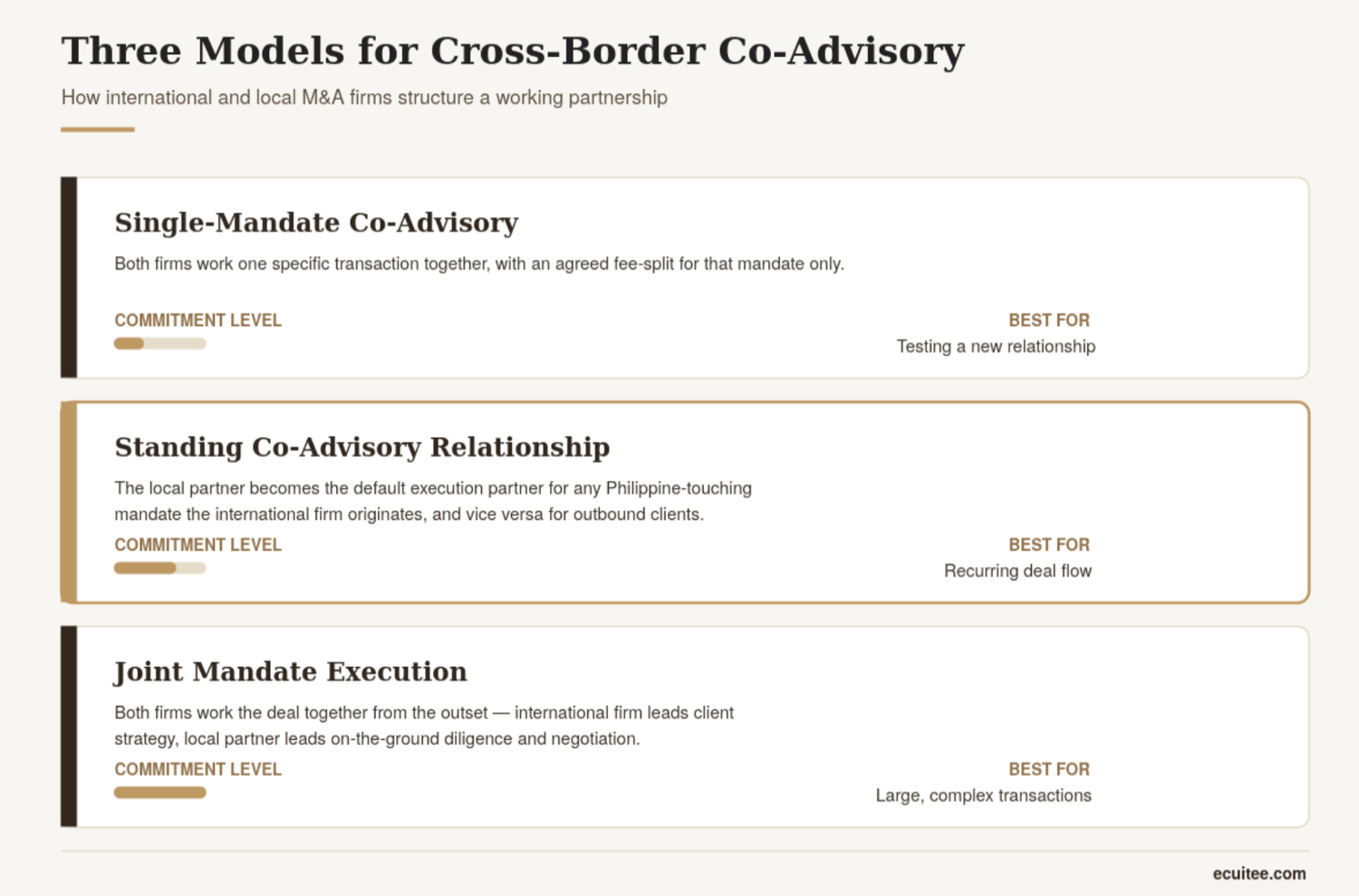
There's no single template, but most arrangements fall into one of a few patterns:
Single-Mandate Co-Advisory
The two firms work one specific transaction together, for example, a client looking to acquire a Philippine target with both teams contributing to execution and an agreed fee-split for that mandate. Lower commitment, useful for establishing working rapport before a deeper partnership.
Standing Co-Advisory Relationship
The two firms establish an ongoing arrangement: the local partner becomes the default execution partner for any Philippine-touching mandate the international firm originates, and vice versa for outbound Philippine clients looking at the international firm's home markets.
Joint Mandate Execution
For larger or more complex transactions, both firms work the deal together from the outset, the international firm leading client relationship management and overall deal strategy, the local partner leading on-the-ground due diligence, regulatory navigation, and local negotiation dynamics.
According to PwC's regional deals commentary, cross-border dealmaking has become one of the more compelling strategies in Asia-Pacific M&A precisely because of how operationally complex these transactions are relative to domestic deals, complexity that a well-matched co-advisory partnership is specifically designed to absorb.
What to Look for in a Philippine M&A Partner
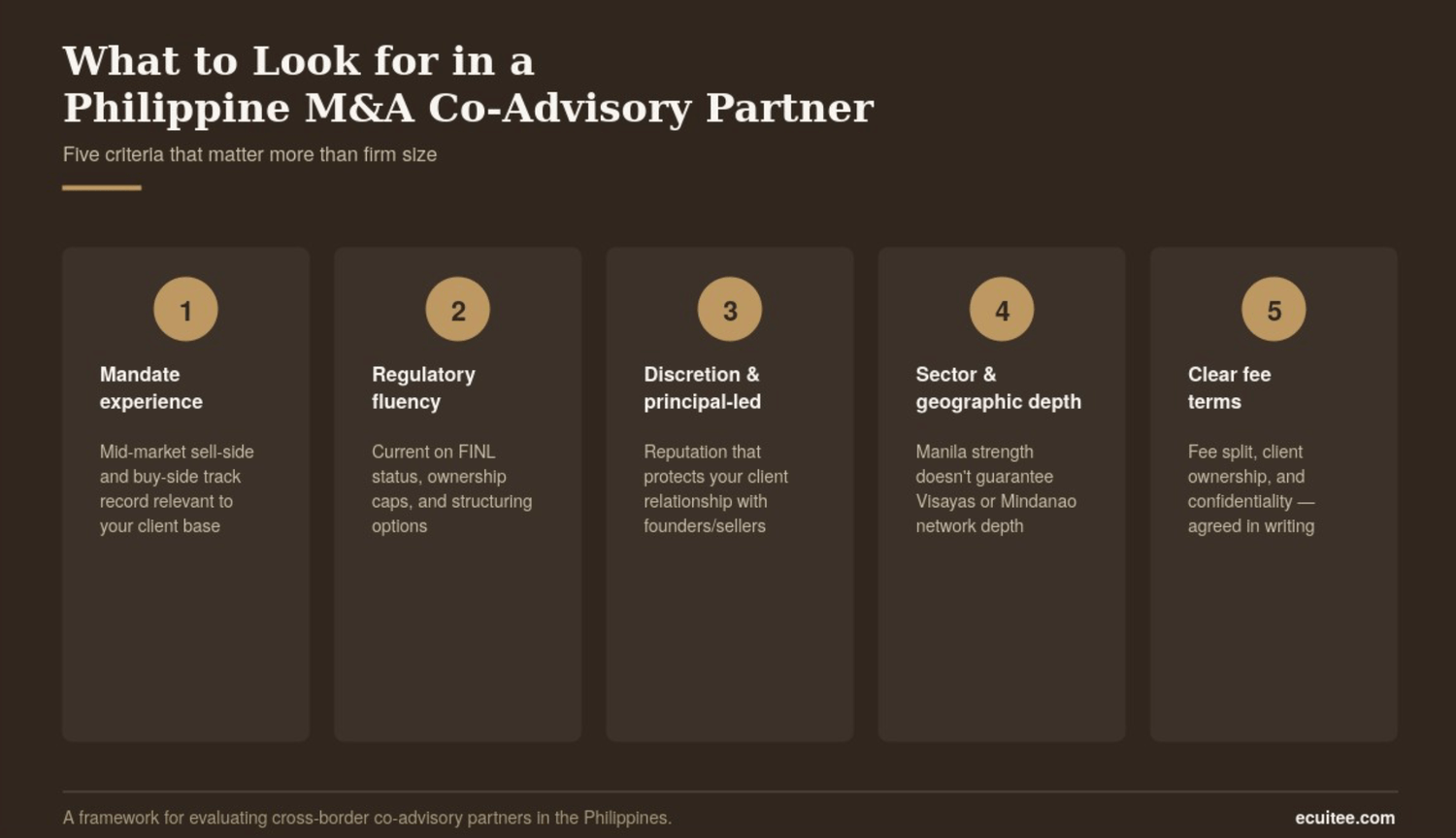
Not every local firm is a good co-advisory fit. A few things matter more than brand size:
Mandate Experience Relevant to Your Client Base
A firm with a track record in mid-market sell-side and buy-side mandates is a better fit for most cross-border co-advisory work than a firm focused primarily on large-cap or public-market transactions.
Regulatory Fluency
Your partner should be able to speak confidently and currently to Foreign Investment Negative List status, sector-specific ownership caps, and structuring options like joint ventures or phased buy-ins, not just general market commentary.
Discretion and Principal-Led Engagement
Philippine sellers, particularly family-owned mid-market businesses, often value a relationship-led, confidential process. Your local partner's reputation for discretion directly protects your client relationship.
Sector and Geographic Depth
The Philippine mid-market is regionally fragmented. Strength in Metro Manila doesn't necessarily translate to credibility or network depth in Visayas or Mindanao markets, which matters if your client's target sits outside the capital.
Clear Fee and Mandate-Sharing Terms
Ambiguity here is a common reason cross-border co-advisory relationships break down. Get the fee split, client ownership, and confidentiality terms agreed in writing before the first joint mandate, not after.
Structuring the Partnership: Practical Considerations
Who Owns the Client Relationship?
The two firms work one specific transaction together, for example, a client looking to acquire a Philippine target with both teams contributing to execution and an agreed fee-split for that mandate. Lower commitment, useful for establishing working rapport before a deeper partnership.
Fee-Sharing Models
Co-advisory splits and success-fee structures, often Lehman-style or modified Lehman formulas, are common approaches. The right model depends on how much execution work each side carries. A partner doing substantial on-the-ground diligence and negotiation work warrants a larger share than one playing a more limited role.
Confidentiality Across Two Firms
Cross-border mandates already carry sensitivity; involving two advisory firms multiplies the exposure if confidentiality isn't handled carefully. Mutual NDAs between the firms, in addition to standard client confidentiality agreements, should be standard practice before any target information changes hands.
Regulatory and Compliance Alignment
Your Philippine partner should be operating within Philippine securities and corporate advisory regulations and should be able to demonstrate familiarity with current Foreign Investment Negative List provisions. This protects both firms from structuring a deal around outdated assumptions about what's permissible.
Why the Philippine Mid-Market Specifically Rewards Local Partnership
A recurring theme in Philippine M&A, one that catches less-prepared international firms off guard, is the prevalence of informal accounting practices among mid-sized, founder-led businesses, particularly in cash-intensive sectors like retail and food service.
Reconciling these issues, structuring around them through asset purchases, Newco arrangements, or phased buy-ins, and negotiating credibly with the founder requires a level of local fluency that's difficult to replicate remotely.
As Harvard Business Review has noted in its coverage of M&A value creation, the deals that succeed are disproportionately the ones where preparation and local execution were taken as seriously as deal sourcing and pricing, a principle that applies directly to why a credible local co-advisory partner can be important to a cross-border Philippine mandate.
How Ecuitee Works With International M&A Firms
Ecuitee is a Philippine-based M&A advisory and business brokerage firm built specifically for the kind of execution work cross-border mandates require: sell-side and buy-side advisory, business valuation, and capital advisory across the country's mid-to-large business segment, with an existing affiliate network and active mandates across multiple sectors.
Visit ecuitee.com for an overview of our practice.
For international firms evaluating a Philippine co-advisory partner, that means:
Principal-Led, Discreet Engagement
A principal-led, discreet engagement model suited to relationship-sensitive Philippine sellers and founders.
Local Transaction Experience
Direct experience structuring deals around the compliance and informal-accounting realities common in the local mid-market.
Foreign Ownership Familiarity
Familiarity with current foreign ownership rules and the structuring options available under them.
Flexible Co-Advisory Arrangements
Flexibility across single-mandate, standing, and joint co-advisory arrangements, depending on what a given relationship calls for.
Clear Fee and Mandate-Sharing Terms
Clear fee and mandate-sharing terms. Get the fee split, client ownership, and confidentiality terms agreed in writing before the first joint mandate.
Learn more about our team , explore our advisory services , or review our Insights on Philippine M&A and valuation practice.
Frequently Asked Questions
What is a cross-border M&A co-advisory partner?
A local advisory firm that an international M&A firm partners with to execute the on-the-ground components of a deal, including due diligence, regulatory navigation, and local negotiation, in a market the international firm doesn't operate in directly.
How are fees split in a cross-border M&A co-advisory arrangement?
There's no fixed standard; arrangements are typically negotiated as co-advisory splits based on each firm's share of the execution work, often using Lehman-style or modified Lehman success-fee formulas as a reference point.
Why would an international M&A firm need a Philippine partner instead of handling the deal directly?
Most international firms lack the regulatory familiarity, local network, and on-the-ground presence needed to efficiently diligence and negotiate a Philippine mid-market transaction. A local partner can close that gap without requiring the international firm to build an in-house presence.
What should I look for when vetting a Philippine M&A advisory partner?
Relevant mandate experience, current regulatory fluency, particularly around foreign ownership rules, a reputation for discretion, and clear written terms on fee-sharing and client ownership before any joint work begins.
Does the Philippines restrict foreign involvement in M&A advisory services themselves?
Advisory and consulting services generally fall outside the most restrictive categories of the Foreign Investment Negative List, though specific licensing and registration requirements should be confirmed for the relevant service line and structure.
Conclusion
The Philippines is generating more cross-border deal flow than most international M&A firms can comfortably execute alone, and that gap is exactly what a well-matched local co-advisory partnership is designed to close.
The World Bank has highlighted improved ease-of-doing-business reforms in the Philippines as a contributing factor to rising foreign investor confidence in the market, a backdrop that makes well-structured local partnerships more valuable as deal activity develops.
The firms getting the most value from Philippine mandates are the ones treating local partnership as a deliberate, vetted relationship, not an afterthought arranged mid-deal.
Looking for a Local Co-Advisory Partner in the Philippines?
If your firm is evaluating Philippine-touching mandates: inbound acquisitions, outbound seller representation, or joint venture structuring, schedule a confidential discussion with Ecuitee to explore a co-advisory relationship built around how your firm actually works.
Schedule a Confidential Discussion